
November 2026

The title of the second chapter of Nobody You Know (my unpublished memoir) is “Fetus,” as that’s me at the time, still in my mom’s belly. Little did she know who she was marrying.
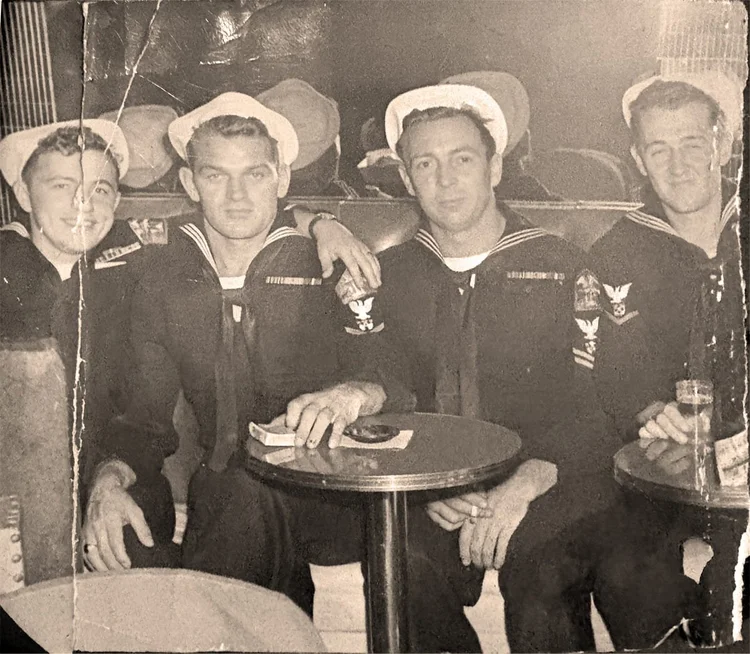
My father, Harold “Pee Wee” Greenblatt, could’ve been one of the sailors on the Brooklyn docks in Hubert Selby, Jr.’s Last Exit To Brooklyn. Crude but handsome, he must’ve cut some figure to my mom Reba Greenfield when she first saw him in a Coney Island candy store. Every weekend she’d go to Coney Island from Newark with a gaggle of giggling girlfriends. The beach was their salvation. They’d sit under the sun and luxuriate in the knowledge that all the boys were giving them the eye. Flirting was now the artform in the late ‘40s. To let the boys, new boys, exciting boys, give you the eye, would do wonders for the ego, and—who knows?—maybe one of those boys would be rich! Reba didn’t miss a weekend at Mrs. Gramowitz’s boarding house.
The courtship was so whirlwind, the marriage plans so exciting, Reba knew she had met “the one.” After all, she was 21 already. She wasn’t getting any younger. And she was hellbent to get out of that Newark neighborhood. She had worked, and given her parents money, for three long hard years. Now she wanted something for herself, and none of the vociferous protests of my grandma Deb and grandpa Gunny could make her change her mind. She didn’t listen. She was in love. She loved everything about him. His crassness, dimples, curly blonde hair and rough’n’tumble ways reminded her of some of her beloved Hollywood mobsters. She even loved how he’d hold his cheap cigar between his second and third fingers while talking about what the future will bring them. Oh, he could talk, alright. She directed her enthusiasm, her passion, to all things Pee Wee. And, in the beginning, he was loving, very loving.
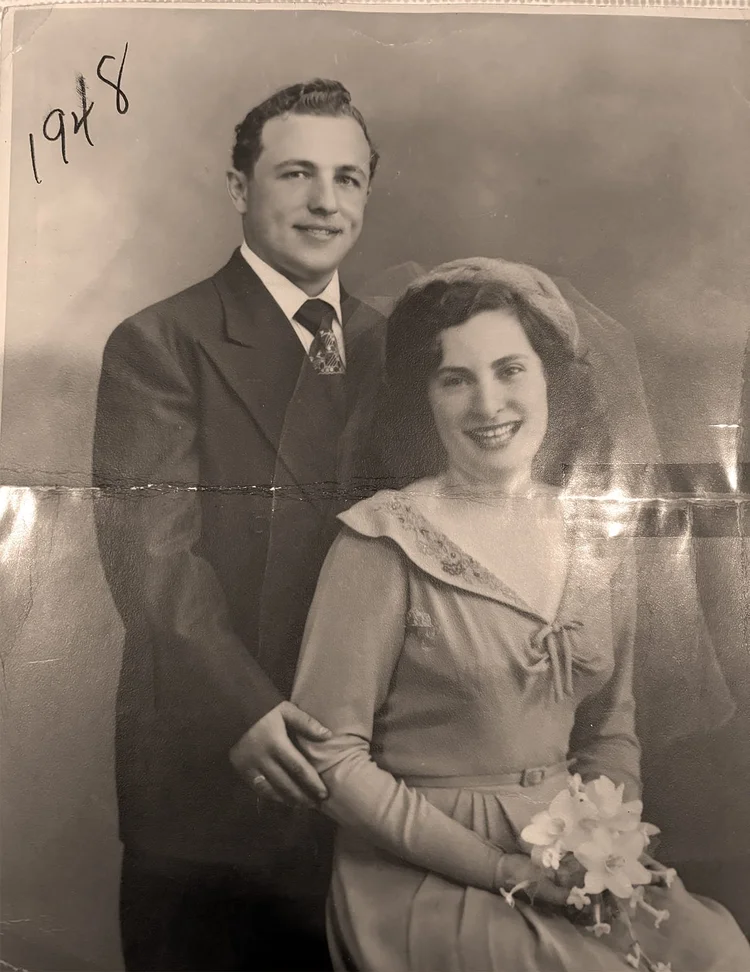
Despite learning more about the short gruff sailor with the big mouth and the big promises—like how he was rather less-than-ambitious, working at the Mermaid Avenue food store of his parents in Brooklyn and robbing them blind—she refused to give an inch to the slightest dollop of negativity. This over-the-top surrender to only the positive would stay with her to her dying day. Like how she’d refuse to ever discuss death. By simply willing it away, it would cease to exist. In so doing with Pee Wee, despite the whole family begging her to wait, the two became one on September 10, 1948, at the Morristown New Jersey home of her uncle Morris (Gunny’s brother) and Aunt Jen. Deb and Gunny could only shake their heads in despair. Having heard the promises, and seen right through them, they still had to learn to accept their new son-in-law. At least he was Jewish.
Life began anew in a third-floor Coney Island walk-up near the beach. Love carried the day for the first few months but soon Reba realized that she still was poor and, now, even worse, alone. Pee Wee drove his cab every night, spent long hours on the road, and spun even longer yarns about how he’d save for a NYC medallion that would earn him the right to own his own damn cab and then, boy, the money would pour in. To that end, he never got the cab, at least while he was married to my mom. He blew all his money on gambling, liquor, his girlfriend and expensive pigeons. Heartbroken, Reba would stay on the phone for hours while Pee Wee trained those pigeons on a rooftop coop with his best friend, Anthony Spero.
Reba had no idea that Spero was the real-life personification of those Hollywood mobsters she so adored. He’d come to the house sometimes and always be the most courteous gentleman to his best friend’s wife, but when he wasn’t on his best behavior in front of Reba, he was rising through the ranks of the Bonanno crime family, to become a consigliere and, ultimately, boss.
Between the roof, the road, the bar and the constant solo visits to his mother, his brother Normie, his girlfriend Katie and some of the mobsters who Pee Wee started ingratiating himself with, Reba was more alone than ever. She never complained. In all her calls to her mom and sisters, she lied that everything was great, maybe not so convincingly, though, because sister Fran started to bring food and money on her more frequent mercy missions. Reba’s aversion to anything negative was getting tested bigtime. She wouldn’t even admit to herself that she was miserable. She’d walk to the beach in the afternoon and sit on the jetties, watching the inexorable flow of the ocean wondering if this is what marriage was supposed to be like.
Soon she was pregnant with me.
Pee Wee bought her a little black’n’white television—her first!—and she loved it. I came along, after eight hours of labor, at 9:35 a.m. on February 3, 1951. Pee Wee promised the world would change and Reba believed him. He’d be the best father, the best husband, he’d stop gambling, he’d work hard. Shortly thereafter, the card games got longer, he’d sit with a bottle on the roof for hours admiring his pigeons while his young wife cried in her kitchen. Plus, he was now doing Spero’s bidding, driving mobsters around Manhattan, transporting drugs from one location to another in his trunk, even using his baseball bat when Spero asked him to in an effort to teach someone a lesson. That, and the occasional liquor store hold-up with the gun he recently received, took up most of his time.
To impress his friends, he’d take me with him, hoist me up on the bar, and I’d sing Kate Smith’s “When The Moon Comes Over The Mountain” and “God Bless America.” I also met the pigeons. I liked to watch them fly and return, amazed at their grace, yet disgusted when I broke one of their eggs in my hand. Once, he took me to a strange apartment, and I witnessed him getting beat up when someone jumped him as we left. Whose apartment was it? Was it his? Was that why we never had any money? Who was the guy who beat him up and why? What fate did the guy endure when my father told Spero about it?
My mother would take me to the beach where I’d play in the sand and she’d go back to daydreaming about escape. She battled depression. Crying seemed to be her only out. One day, Pee Wee went out for cigarettes and never came home. Deb and Gunny never once held it over her head. With no food or money, we were forced to move down the street into the cramped apartment of a friend whose husband obviously didn’t want us there.
“By the time I was 22,” Reba wrote in her diary, “I felt like I was 42.”
I hated it there. Neighborhood toughs would put small thorns through newspaper and, while holding me down, stab my bare back. They stole my baseball cards. A crazy old lady would pour boiling water out of her window at me when I played in the courtyard. Weeks later, my father came a’callin’ demanding to see me. My mother refused. He started loudly banging on the door, yelling profanities as my mother and I huddled on the other side. The cops were called. With a burst of force, my father broke the glass part of the door and—while my mother screamed bloody murder—tried reaching inside for me with bloody knuckles. That’s when the cops came. But they didn’t know those roofs as well as my father. They came back and apologized for losing him. I didn’t see or speak to my father again for 20 years.
What my mom and I didn’t know was that Pee Wee borrowed Uncle Normie’s car and despite telling his brother he’d bring it back in a few hours, drove to Chicago with Katie where he had a daughter, Susan, and stayed six months before ending up in a Chicago hospital when Katie tried to stab him to death with a carving knife after a violent argument.
Reba gathered up her strength, her stuff, and headed out with me to Newark, New Jersey. The divorce was in the works. My deadbeat dad got off scot-free: no alimony, no child support, no calls on my birthday. He just vanished. My mother never really pursued it. As she stuffed me in the backseat of the car between the mop, ironing board and clothing, a friend drove us to our new home on Alpine Street in Newark, NJ where she worked and I went to nursery school.
“Does everyone live like this,” she wrote in her diary, “always ironing, cleaning and being poor?”
We didn’t last too long alone together, especially with no support from Pee Wee. So she moved back in with Deb and Gunny, who were now on the Hillside/Newark border at One Grumman Avenue, on the corner of Elizabeth Avenue, across the street from Weequahic Park and its 9-hole golf course. I grew to love that neighborhood. At first Reba took a bus to Newark News Dealers downtown but when Newark News Dealers became Hudson County News Company in North Bergen, Reba had to schlep on three busses there and three busses back. Deb took over the parenting.
How I loved to sit on the piano bench with my grandmother and watch her fingers as she played “Beautiful Dreamer,” “The March Of The Wooden Soldiers,” “Wedding Bells (Are Breaking Up That Old Gang Of Mine),” “I’m Forever Blowing Bubbles” and, my favorite, Franz Von Suppe’s 1846 “Poet and Peasant Overture.” That dramatic Russian overture always had me on the edge of the piano bench anticipating its mounting crescendos. I’d always ask her to play it again and again and she’d try to oblige every time, until, eventually, old age crept into her fingers and made ‘em shake so she just couldn’t play it anymore. And the books! Oh the books! She’d meticulously write her name and an original poem in the blank page of each book in her flowing script. Gentleman’s Agreement, For Two Cents Plain, Tropic Of Cancer, The Good Earth, and plenty of Saul Bellow, Philip Roth, Bernard Malamud, James Michener, John Steinbeck, Ernest Hemingway and all those Russian authors whose names I couldn’t pronounce. Yeah, my grandmother was a real cool cookie alright.
Most evenings we’d gather around the television. I’d be on the floor curled up at my grandfather’s knee. He’d be on the rocker to my right; Deb to my left on the overly plush chair crocheting; mom alone on the couch against the back wall. We would watch a steady diet of Gunny’s beloved westerns, game shows, sitcoms, pro wrestling and The Ed Sullivan Show.
All Mike Greenblatt has ever done in his entire life is listen to music and tell people about it — as a New York City publicist, editor, and freelance journalist.
Five decades of chronicling rock'n'roll, blues, jazz, folk, soul and country, starting in New Jersey as Music Editor of the Aquarian Weekly, then in New York as editor of Modern Screen's Country Music, Wrestling World, and Metal Maniacs.
His writing subjects fill the Rock and Roll Hall of Fame: Joe Cocker, Graham Nash, David Crosby, Carlos Santana, Bruce Springsteen, Paul McCartney, Johnny Cash, members of The Rolling Stones and The Beatles.
His book Woodstock: Back To Yasgur's Farm came out in 2019. He currently edits The Jersey Sound and contributes to Goldmine Magazine and The Aquarian.