
Jersey’s Golden Door: Grammy-Winner Julie Gold Looks Back at Immigrant Legacy in New Short Film

Julie Gold
The road to legendary American songwriter status?
For many, it could only have begun in New Jersey.
Such is the story behind a new short film entitled “Harbor of Hope,” tracing the life and legacy of “From a Distance” composer Julie Gold and her Russian American mother, now an official selection of NJ Web Fest 2026 (September 24-27) at the Clairidge Theater in Montclair.
The film follows Gold on an afternoon at Jersey City’s Ellis Island, where countless immigrants—her eight-year-old mother, later known as Ann Olinsky Gold, among them—found their pathway to freedom through America’s famed “Golden Door.”
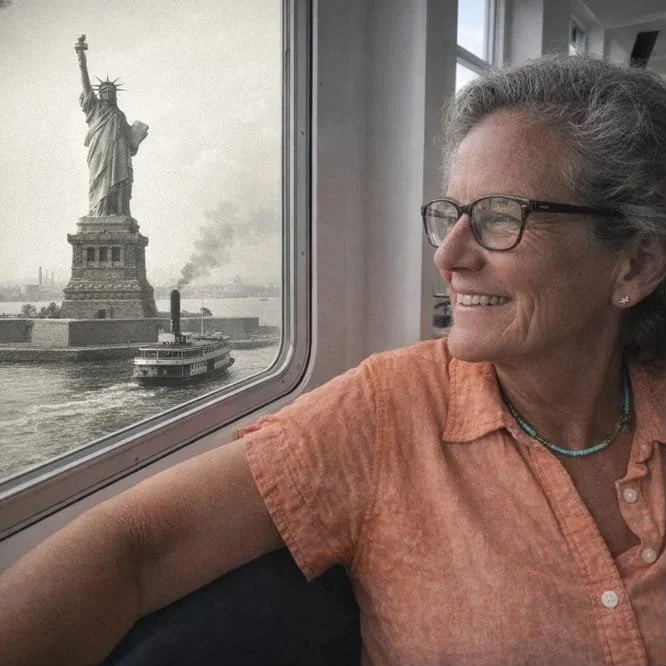
Grammy-winner Julie Gold follows in her Russian American mother’s footsteps for a day in “Harbor of Hope.”
The venture is part of an ongoing anthology from New Jersey’s own Brad Forenza called Slice of Life: a series of brief, insightful profiles designed to commemorate America’s 250th year. A Ridgewood High School and Rutgers University grad, Forenza is a writer, producer, public scholar, and all-around student of the human condition, with previous projects that include the award-winning episodic audio drama Around the Sun and The Public Figure Songbook, an album of tunes exploring the scandals, trials, and tribulations of flashpoint figures in American history.
Naturally, a movie about a musical icon with a family history that stretched back through his home state felt, to Forenza, like a beautiful fit.
When asked about the origins of the project, Forenza is quick to cite Gold’s artistic enthusiasm and their shared tri-state roots as inspiration. “Julie Gold is such a generously wonderful spirit,” Forenza says, adding, “People who know her career arc are likely familiar with the evolution of her beautiful, Grammy-winning composition, ‘From a Distance.’ But, like so many artists, that’s just one song from Julie’s vast, tuneful portfolio. I gravitate to many, including her song ‘Goodnight, New York,’ which honors her mother’s intercontinental journey to Jersey’s ‘harbor of hope.’ I also appreciate ‘Tiger in New Jersey,’ which—like many of Julie’s songs—is a call for compassion and perspective. And, while I don’t know for sure, I imagine Julie’s composition ‘Southbound Train’ could have been written on any number of her railway commutes through the Garden State, en route to visit her beloved mother.”
The film, though always conceived as a tribute to Gold’s music and heritage, owes a lot to serendipity, as Forenza explains. “On the cusp of America’s 250th year of independence, I wanted to spotlight a specific part of the [American immigrant] experience and use Julie’s song ‘Goodnight, New York,’ as the catalyst to do so. Julie obliged, and, when I told her I’d be going to the Statue of Liberty and Ellis Island to collect B-roll footage, she indicated she hadn’t been in years and wanted to seek out on record of her family’s journey. And this—though neither of us predicted how hot it would be that day—is how my idea of producing a ‘mini-mentary’ on immigration became a cornerstone episode of Slice of Life.”

Forenza and Gold arrive to film at Liberty and Ellis Islands in 2025
Gold, too, has expressed deep affection for the episode and the unexpected (literal) sweat and tears it took to complete. “It was the hottest day of last summer,” she recalled, noting, “[Forenza’s] vision was to honor my dear mother and her heroic journey to America in 1930. I cherish the resultant profile, Slice of Life: Harbor of Hope, and the way it celebrates so many immigrants and their sacrifice for our dreams.”
Indeed, dreams—deferred, past, and present—are at the center of “Harbor of Hope,” as when Gold introduces the film, announcing:
“I’m a musician. I’m a songwriter. I have gotten to live the American dream, and I am revisiting where my mother came through when she was eight years old in 1930.”
Later, when asked how her mother must have felt upon arrival at New Jersey’s storied harbor, Gold remarks on the acute sense of fear the “American dream” must have carried with it, especially for younger immigrants:
“My mom was probably terrified. I don’t know what she thought; they didn’t know anything.”
Still, Gold observes, there was always hope:
“I’d like to think she felt welcome.”
However bittersweet her mother’s journey, there’s no doubt in Gold’s mind that her mother’s courageous crossing made “From a Distance” and all the many songs in Gold’s repertoire possible. “I’m grateful for my mother’s heroic sacrifice so that my brother and I could live our American dream; I’m…I’m never gonna stop saying it,” she declares as images of her strolling past Ellis Island’s “Wall of Honor”—where her mother’s name is etched in stainless steel—float across the screen.
At another critical moment, Gold muses on how her career brought her mother’s journey to America “full circle,” from one literal American landmark to a figurative, musical one. “My mother is an immigrant, and ‘From a Distance’ is written into the Congressional Record!” she exclaims, poignantly drawing a direct line from Ellis Island to her own history-making melody.
Over the course of the episode, Gold also hints her family’s decision to emigrate granted her the persistence and perspective necessary to become the artist she grew into as an adult. Prompted to explain what it’s like to see life through her eyes, Gold points to a willingness to take the good with the bad, the scary with the exciting:
Forenza: So, what does it mean to see the world as an artist?
Gold: To see all of it, in every dimension. In every color. In every season.
Yet it’s clearly joy and gratitude that keep her moving forward.
“Thanks, Mom!” Gold shouts with arms outstretched as the credits roll, giving a warm embrace and nod to one of the most iconic waterways in the world: the place where her songwriting legend began.