
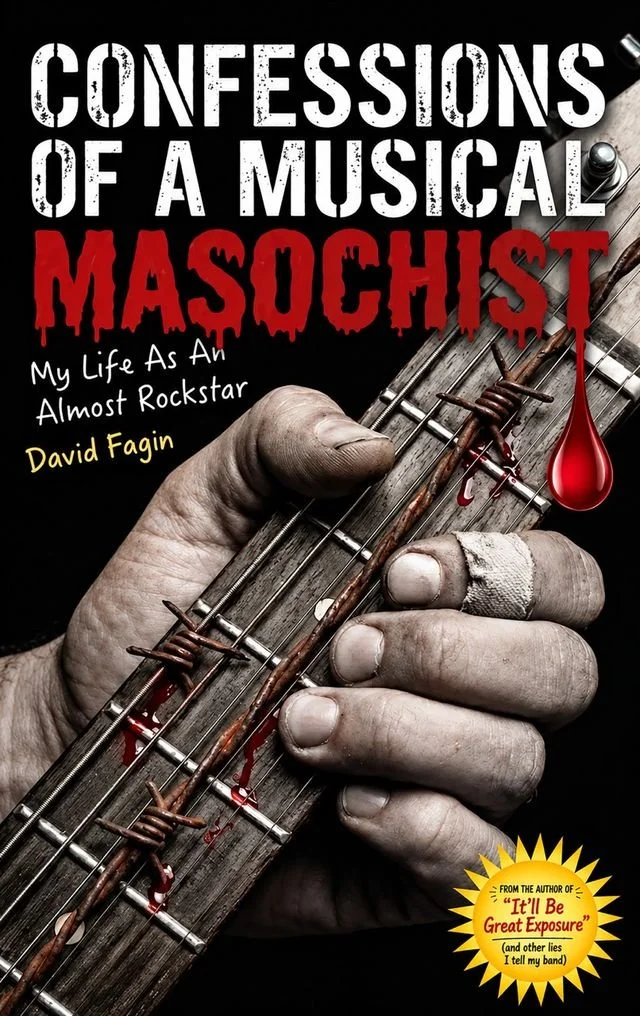
Confessions Of A Musical Masochist: My Life As An Almost Rock Star
by David Fagin
(Scout Media/Noshpit Entertainment)
In 1953, Julius and Ethel Rosenberg were put to death by the United States government for treason. Forty years later in 1993, David Fagin formed The Rosenbergs out of his Lyndhurst apartment. They won K-Rock New York’s “Best Unsigned Band” contest in 1996. The well-received Ameri-Pop debut came out in 1999. It was self-financed Power Pop to the max and they followed it up with Mission: You in 2001 with the help of King Crimson’s Robert Fripp. Department Store Girl came out in 2003 and it got them on the cover of the Aquarian Weekly.
Yet through it all, Fagin was more than just a singer-songwriter-guitarist-frontman. He became a staunch artist-rights advocate, refusing a major television slot over contract terms. Instead of running in the opposite direction when Napster turned the music-biz upside-down via file-sharing, he partnered with them. He testified before Congress. He worked with the Muppets. He wrote the theme for a CBS-TV sitcom. He partied with Slash. But, time and time again, he’d get fucked. Whether it was fickle bandmates, shady lawyers, incompetent accountants, faulty equipment, unscrupulous club-owners or fine-print disappointments, Fagin always got fucked. Every time. It’s almost as if the rock’n’roll gods were spitting on him. Case-in-point: hours before The Rosenbergs were to open for Duran Duran at Jones Beach, Fagin found himself in a Bergen County holding cell for shoplifting sushi.
But he always just wanted to rock out on a stage with his friends and drive patrons nuts and he was always good at it. So after years of chasing the dream, in Fairlawn, in Fairview, in Edgewater, in Hoboken, in Belleville, in Jersey City, in Hackensack, or in Mahwah, he just about gave up and started a Jersey cover band playing five sets a night—40 on 20 off—and lugging your own equipment up and down stairwells at ungodly hours. No more roadies. No more groupies. A descent into the maelstrom of cover-band hell could really do something to a singer’s psyche.
“Did I really want to return to a life filled with relentless rejection? To my surprise, my answer was: why the fuck not? Although, in hindsight,” he writes, “I had no idea what I getting myself into. The New Jersey cover scene would turn out to be a 24/7 tour-de-farce populated by liars, morons and scoundrels. And that’s just your bandmates. Add in all the grudges, black-listings and back-stabbings and you’ve got enough negative energy to put the state of Illinois on Pluto. To put it in context, it’s basically like Capitol Hill with guitars.
“In the original-music scene,” he continues, “99% of venues provide sound and a sound engineer. In the cover scene, it’s practically an accident if a venue has its own PA. And good luck if you’re hoping for a stage. And I’m not talking about a plank of plywood six inches off the floor…One thing I learned very quickly: on the cover scene, talent doesn’t mean shit…venues couldn’t care less whether your band was good. All that matters is your draw. If you sound like a bag of dicks but pack the room, you’re hired.” Fagin is funny. Throughout. In fact, he’s hilarious. Laugh-out-loud hilarious. It makes his memoir not only eminently readable but with enough universal truth to fill its 430 pages.